Tuesday, July 1, 2014

Shall We Gather at the River??


Shall we gather at the river,
Where bright angel feet have trod,
With its crystal tide forever
Flowing by the throne of God?

Refrain:
Yes, we’ll gather at the river,
The beautiful, the beautiful river;
Gather with the saints at the river
That flows by the throne of God.


This morning finds us on the banks of the Jordan River, in the vicinity of the place where John the Baptist baptized Jesus, where the Israelites crossed over into the Promised Land, and where Elijah was taken up in a whirlwind into heaven.  A lot of Christian history in one small area!


The exact spot of the baptism is lost to the ages.  Two dueling spots are located in this area, one on the Jordanian side called  Beitabara and the other on the Israeli side in the West Bank, called Qaser El Yahud. We visited the Israeli area.


Following the six-day-war in 1967, this baptismal area was located in a military zone, and was off limits to civilians.  As the Israelis began to clear the landmines, the site was opened during the Easter season, and then gradually by appointment. When we went it was open on a regular basis, though the land around the site remains treacherous.


The Jordan River is very narrow and muddy at this site. Much of the water is diverted upstream for irrigation.  It is only feet across in spots. You feel you could almost reach out your hand and touch the soil of the sovereign state of Jordan.  There remains a military presence on both sides of the river.


Here we read Luke 3:1-22. "When everyone was being baptized, Jesus also was baptized.  While he was praying, heaven was opened and the Holy Spirit came down on him in bodily form like a dove. And there was a voice from heaven: "You are my Son, whom I dearly love; in you I find happiness." Luke 3:21-22. Just as Willis Britt read these words, three perfect white doves flew over the site. It was definitely an "aha" moment!  Not long afterward the baptism, John the Baptist was arrested. This was the signal for Jesus to leave his trade and begin his public ministry.


We went down to the water's edge where we renewed our baptismal vows and were anointed with water from the Jordan River. We were able to collect our own bottles of water to take home.  Once the silt settles from the water, it is amazingly clear.  Many people use it in infant baptisms.


According to Bargil Pixner, there were three stages in the development of the rite of baptism.  First there was baptism of self - ritual cleansing, such as in a mikveh, for ritual purity.  Secondly there developed baptizing by a baptizer as a sign of conversion and repentance in preparation for the kingdom of heaven, and finally Christian baptism, the effective sign of entry into the Kingdom of God.


Why did Jesus need to be baptized?   Because he was sinless, Jesus did not need to be baptized.  His baptism demonstrates to us that he identifies with us, sinners.  It gives Jesus credibility with the followers of John the Baptist. By baptizing Jesus, John gave him his stamp of approval as his successor. The baptism was also a perfect picture of the triune God - the Son, the Father's voice from heaven, and the descending of the Holy Spirit. "God in three persons, blessed Trinity."

Sunday, June 29, 2014

The Bedouin


"And there were in the same country shepherds abiding in the field, keeping watch over their flock by night..." Luke 2:8.  I admit, I was surprised to see the shepherds in Israel.  Somehow they didn't look like they had in the Christmas pageants!


Dating back to the days of Abraham, itinerant shepherds wandered throughout Israel, searching for grazing lands for their flocks.  The only people continuing this profession in the Middle East are the Bedouin, mostly Muslim Arab's who travel in the age-old manner, searching for grazing lands.  Many winter in the Negev Desert, where there is enough rainfall to support a harvest of winter wheat without additional irrigation.


The Bedouin use the wool from their animals, creating traditional crafts which they sell in the markets and buy mass-produced clothing for themselves.


Many Bedouin no longer live in tents. They squat in rough shelters built where the grazing is good. Many are actually very wealthy, choosing to maintain the ancient lifestyle for at least part of the year.


The Israelis are putting a tremendous amount of pressure on the Bedouin.  They want them to stop wandering, register, and settle down in special settlements.   The Bedouin struggle to preserve their ancient culture through their music and storytelling.


Ir is almost easy to envy a free lifestyle, under the wide-open sky. "God made the wild animals of the earth, of every kind, and the cattle of every kind, and everything that creeps upon the ground of every kind. And God saw that it was good." Genesis 1:25.

Sunday, June 22, 2014

Bethlehem Bible College


This morning, March 10, 2104, we checked out of the Angel Hotel.  As we prepared to leave Bethlehem, we stopped for a visit at the Bethlehem Bible College.  As you will recall, Bethlehem lies in the West Bank, a Palestinian area, where only approximately 1.5% of the residents are Christian.

In 1979, Bishara Awad was the principal of Hope Christian School in Beit Jala. He saw that many of his students went abroad for a university education, and that most of those who chose to study theology never returned.


With an initial donation of $20, Dr. Awad went on to build a Christian Bible college to educate Arabs to serve their churches and communities. The College does receive funding from the United Methodist Church.


Today the college has expanded to offer:

BA in Biblical Studies & Christian Education
MA in Christian Ministry
Diploma in Media Studies
Diploma in Tour Guiding
International Studies Programs

By giving Arab students an opportunity for higher education, they hope to encourage the Palestinian people to seek a better life.


We enjoyed getting to meet Dr. Awad. His brother, Alex Awad, documented the story of their family and the founding of the Bible College in his book Palestinian Memories. Here Dr. Awad signs a copy of the book for my daughter, Savannah. Dr. Awad gave a very interesting talk about the difficulties of living and learning in the occupied territories, as well as the special problems facing Christians.


While we were at the Bible College, their 3rd Biennial Christ at the Checkpoint conference was beginning. At this conference more than 600 people met to pray, worship, and discuss the role and responsibility of the church to work to bring peace to the Holy Land. For more information see www.christatthecheckpoint.com


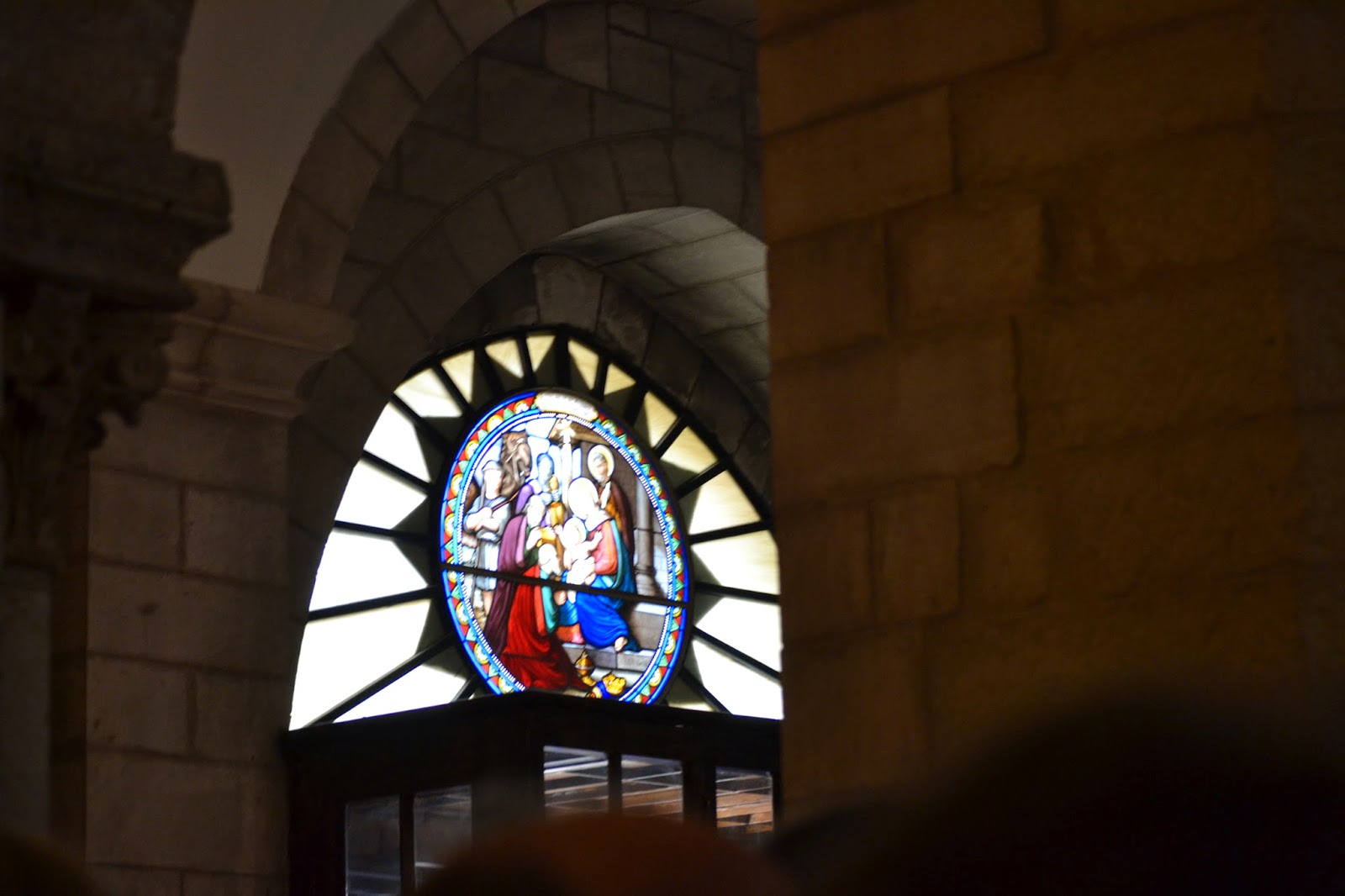
The students love Bethlehem Bible College!  A former student wanted to give something back, so he went on YouTube and taught himself how to make a stained glass window.  With no other training, he made this beautiful window and donated it to the school.


Bethlehem Bible College: Serving the Lord in His Land. It was a great visit. For more information go to www.bethbc.org

Follow by email!


My sweet friend, Patsy Wood, suggested that I add a way for people to keep up with updates to the blog via email.  I did just that.  On the right hand side of the page, above my picture,  is a box for your email address.  Fill it out and updates will come to you automatically.  Thanks for reading along!

Monday, June 16, 2014

"And the Word was made flesh"...The Church of the Nativity


After lunch on March 9, 2014 we headed to the Church of the Nativity. This is one of the oldest Christians structures. After the Edict of Milan, in 313 AD, Christians emerged from the shadows and began to freely identify their holy sites. In 326, Helena, the mother of Constantine, took a pilgrimage to the Holy Land. She identified three main holy sites "mystical grottoes" where she ordered basilicas be constructed. These were sites that had been revered since the early days of Christianity and included the Church of the Nativity.


A portion of the mosaic floor from the original basilica has been exposed.


The original structure, built by Constantine in the 4th century AD, was enlarged and embellished by Emperor Justinian in the 6th century AD, after it was damaged by rebellious Samaritans. Over time, the building was expanded by the addition of chapels and monasteries. On the south side are the churches and monasteries belonging to the Armenian and Greek Orthodox churches. The Franciscans are located at the northern end. The facade at one time was decorated with a colorful mosaic, which saved the church from destruction in 614 AD when almost all the structures in the Holy Land were destroyed by Persian invaders. Upon seeing the depiction of the magi from Persia, the Persians let the church stand, out of respect for their ancestors.


Some 300 years later, the church again was threatened by Islamic Arabs. Their leader, Omar, spared the place where their prophet Issa (Jesus) was born. The Mosque of Omar was erected outside the church to commemorate this event.


The original church had three entrances. Two of them have been bricked up. The existing entrance was the central entrance. It was lowered even further during the Ottoman era, to keep horsemen from being able to ride into the church. The present opening can only be passed by bending your head and knees. "Lower yourself, you proud one, if you want to approach God, who for your sake came to us a child." It is often referred to as the "Door of Humility."


The interior is divided into a central nave and two side aisles. The stone for the supporting columns was quarried in Bethlehem. The church is in disrepair. No repairs can be made without the agreement of all the churches represented, and of course no agreement has been reached. Since the church is located in the West Bank, the Palestinian President "convinced" them to at least repair the roof and windows. The wood covering the limestone columns is to protect them during the renovation.


The Holy Land has a very strong Tour Guides Union. Though we were traveling under the auspices of the Jerusalem Center for Biblical Studies and had a teacher, not a guide, we were still forced to employ a Palestinian Arab guide for the Church of the Nativity. I am sure that Amro is a really nice guy, but I would have much preferred the tour be conducted by our Christian Bible teacher! It also became very obvious that bribes could be given to grease the wheels and avoid lines. Our teacher, Willis, chose not to do this, and we waited patiently in line. An Italian tourist behind us became very irate when officials allowed these "special" people to cut in line.


We entered through the Greek Orthodox portion of the church. It was very dark and beautiful. Golden icons gleamed in the candlelight. The scent of incense and burning candle wax filled the relatively small space.


Bearded monks moved silently among us as we jostled for position.


All eyes became focused on the small doorway and the steps leading down to the grotto. As we descended, it became cooler and strangely quite. We were approaching the spot where the Word was made flesh!


Under a small altar is the fourteen-point silver star embedded in marble marking the spot where Jesus entered the word. The inscription reads "Hic de Virgine Maria Jesus Christus natus est" - "Here Jesus Christ was born to the Virgin Mary." An old Oriental liturgy says "In this place heavenly love became manifest in our world. Hope was reborn and peace embraced the earth."


Down three steps is the altar of the magi, which faces the marble covering over the rock where the manager rested. "And this shall be a sign unto you; ye shall find the babe wrapped in swaddling clothes, lying in a manger." Luke 2:21.

We could not linger in this sacred place, but had to move on to admit other pilgrims.


We exited through the Armenian portion of the church, where the altar was covered for Lent, and the walls were adorned with ancient frescoes.


The Church of St. Catherine was built adjacent to the Church of the Nativity.


As you descend the stairs in St. Catherine's church, you come to the Cave of the Holy Innocents. This cave was named in memory of the male children who fell victim to Herod's paranoid fear described in Matthew 2:16 after the birth of Jesus. It is not believed that children were ever buried here, but it seems a fitting place to pay tribute to these children. It is also believed that this may have been located at one of the original entrances to the Grotto of the Nativity.


The main altar in this underground complex is devoted to St. Joseph. He is said to be the one who selected this cave for the birth of Jesus. It was also here where it is believed Joseph experienced the dream which caused their flight to Egypt. 'And when they (the magi) were departed, behold, the angel of the Lord appeareth to Joseph in a dream, saying. "Arise and take the young child and his mother, and flee into Egypt and be thou there until I bring thee word; for Herod will seek the young child to destroy him.' When he arose, he took the young child and his other by night, and departed into Egypt: and there until the death of Herod." In this space we had time to think about our earthly fathers, and the role they play in our lives.


In 386 AD the Dalmatian priest Jerome arrived in Bethlehem from Rome. He had always wanted to translate the Old Testament from the original Hebrew into Latin. When he was in Rome he was the secretary to Pope Damasus and did not have time for this venture. He secluded himself in a cave near the Grotto of the Nativity to study the Bible and undertake this work. While he was in Rome, he had attracted a circle of women who wanted to strengthen their faith. One of these women, Paula, and her daughter Eustochium, followed Jerome to Bethlehem, where she founded a convent near the Cave of the Nativity. When she arrived in Bethlehem, Paula said, "Yes, this will be my resting place; since the Redeemer himself has chosen this as his residence, this is where I too want to stay." Notice the skull under Jerome's foot. Some say it symbolizes all the death in the Bible, while others opine it is because he wanted to give up his translation of the Bible, but could not bring himself to.


Beneath St. Catherine's Church is the Cave of Jerome. Jerome spent thirty years here, working on his translation. Paula, her daughter, and St. Jerome are all buried in a crypt here.


Amen!


We end this very emotional day back in our Bethlehem hotel.