Sunday, October 11, 2015

Is Christianity a Participatory Sport?


How many of us went to "Club Church" today? Did we daydream through a "touchy-feely" sermon about grace without accountablility, sin without consequence, right without wrong? Did we then rush to a restaurant for lunch and then home for a lazy afternoon nap? Were we satisfied, even pleased, with this routine? Easy, routine, predictable.

I heard a very different sermon. Truth is, we are called out of the routine of this Sunday rut. Part of our birthright as Christians is a call to action. Our Christianity is meant to be lived out. We are called to take Christ into the world, not hide him Him under a bushel basket. Christianity is meant to be a verb, a plan for action.

Many of us are dissatisfied with the state of our nation, and even of our world. We blame politics, finances, and even global warming for what bothers us. Perhaps the problem lies with none of these. Perhaps our problem is a problem of the heart. I don't personally ascribe to the theory that the date of the Apocalypse can be calculated by counting blood moons and monitoring the actions of Gog and Magog. I do, however, feel an urgency to pray for open hearts, open minds, and open mouths concerning the Gospel of Jesus Christ.

As Christians we are called to take action to improve the world's situation by changing minds, attitudes, and hearts. The solutions we offer don't come with a new election cycle, quantatative easing, or reducing our carbon footprint. God doesn't want to be anyone left behind. We need a plan of action. This is what was laid out for us this morning by Rick Pigott:

1. We are called to share God's word with the world, showing how our lives have changed and how this change can work in the lives of others. How beautiful are the feet of those who preach the gospel. Romans 10:15. Always be ready to defend Jesus Christ and tell the truth. 1 Peter 3:15.

2. The persuader is not us, but the Holy Spirit. He will convict the world of sin. John 16:8. It is the Father who draws people, not us. John 6:44.

3. Our authority is the Holy Scripture. How we "feel" is of no value. We need to just share the Word of God, our commentary is unnecessary. God's word is like a fire, like a hammer. Jeremiah 23:29. We just need to pass God's word on. Isaiah 55:11. The Word of God is living and powerful. Hebrews 4:12.

4. Our message is Jesus - not church, religion, or Christianity. We usually find it easier to talk about church than Jesus. Philip proclaimed the good news of Jesus to the eunuch. Acts 8:35. We are to preach Christ, and Him crucified. 1 Corinthians 2:2.

We need to keep our eyes open always. We have an important message to share about being in a relationship with Jesus Christ, having our sins forgiving, and receiving the gift of eternal life.

Our mission is clear and the call has gone out. Who will answer?

Tuesday, September 29, 2015

Got glue? #broken4jesus


As I was listening to the radio, I heard someone talking about authentic Christianity.  He posited that only a person who had been "broken" could become an authentic Christian. His research revealed that only approximately 6% of professing Christians reported being "broken" in the past, resulting on a large number of inauthentic Christians.

What do you make of this theory? How many of us will acknowledge that sin, addiction, self-centerdness, greed, or any number of other issues have caused us to turn away from God? Was there a moment when we hit bottom, acknowledged our shortcomings, and fought our way back to God? Is this a necessary step in our Christian journey?

Dietrich Bonhoeffer reminds us that our journey is NOT about us. Our brokenness is not what is important. "To deny oneself is to be aware only of Christ and no more of self, to see only him who goes before and no more the road which is too hard for us. Once more, all that self denial can say is: 'He leads the way, keep close to him.'"

Broken, shattered, or relatively whole, God calls us all. There are no prerequisites, no entry requirements. We must, however, die to self and put God first. No glue required!

Sunday, September 20, 2015

Are You Limited?


Today in church we had the privilege of hearing from Jimmy and RoxAnne Cox, missionaries in South Korea.  RoxAnne spoke of how they work in South Korea to train missionaries, and Jimmy preached our sermon.  His text was Acts 16:1-10. 

As Paul was beginning his Second Missionary Jouney, he intended to travel to more of Asia Minor, taking seriously his call to be the Apostle to the Gentiles. A Man from Macedonia (probably God Himself) appeared to Paul in a vision, imploring him to come to Macedonia.  God hadn't placed a limit on Paul's mission field.

Like Paul, most of our limits are self-imposed. Oftentimes these limits are actually contrary to God's will for us.  Our call is always to follow Christ, which may require that we leave our comfort zone. As we feel God beginning to stretch us, we should not be afraid to follow through.  When we step out in faith God is already there!

Please remember in prayer the Cox family and all others in the missionary field.

Monday, August 31, 2015

#sinmatters


There is a spirit of lawlessness and evil settling over our society.  It is motivating people to do bad acts.  We need look only as far as the many recent poice shootings and the shootings of the news team in Virginia. How should we respond? What should we do? What is the source of this problem?

Politics, money, and passing new gun laws cannot solve our problems.  I believe that God calls us to identify the problem as sin.  Unless human hearts are changed, nothing in the world will change.

We are called into an evil world to preach Christ, and Him crucified.  We need to show others what God has done for us. In isolation, this is difficult to do. When we think it all depends on us it's easy to come up with a thousand reasons not to press on. We need to take Christ into the world from a strong community of believers.

Who needs to hear from us? Everyone! When Jesus healed the leper, He was showing that His message was for everyone, even those on the fringes of society.  Leprosy was symbolic of the sin permeating the world in the time of Jesus.

Our society is so ready to deny the existence of Satan and Hell.  Many worship opportunities include bands, movies, the prosperity gospel, and feel-good theology where everyone's a winner and there are no expectations. If we can't name the sin that is overtaking our land, we will never be able to work to extinguish it.

I believe that it is time to call our nation to prayer - to pray for a revival of our national spirit and our spiritual health. We need to pray to God to stir the heart of our country and that the fog of evil be lifted. Let's gather our faith community together and take that first step. If we believe that our God can physically raise the dead, He can also raise a nation dead to sin. Deliver us from evil!

Monday, February 2, 2015

The Emperor Has No Clothes!


This is one of my favorite fairy tales!  Two fast-talking "tailors" hodwink the Emperor and all his staff into believing that they are creating the finest clothes for him.  They are crafted from the most beautiful and expensive materials, and the clothes are quite the sight to see!  The tailors proclaimed that only the most stupid and ignorant could not recognize the beauty and quality of the clothing.The Emperor has surrounded himself with "yes" men, who corroborate the claims of the tailors. These are the most magnificent clothes ever created! The Emperor looks amazing!

The Emperor is persuaded to process throughout the town, giving the entire populace a sight of his glorious clothing.  Ohhs and aahhs fill the air. The Emperor is praised and feted at every turn.  Finally a small voice piped up, "But he has nothing on!"  As this was whispered and repeated throughout the crowd, the noise grew, and the people began shouting "The Emperor has no clothes!" Vain til the end, the Emperor hears their cries, but continues to parade back to his castle.

As a fairy tale, on the surface the story is funny - a fable to entertain children.  There is more to this story, however, a moral in fact.

How often do we ignore things happening right in front of us, pretending that they don't exist?  Are we carried along on the wave of public opinion, afraid to express our opinion that might run counter to "popular thought?"

Do we have leaders in our nation, our state, our city, and even our church whose nakedness cannot be exposed? Are we forced to toe the party line and deny evil being flaunted in our very face? Have we given up our right to dissent? Is political correctness now the arbiter of right and wrong?

Jesus spoke very clearly about liars and hypocrites.  His execution was most probably hastened by his very public opinions about the authorities of his time.  "How terrible for you legal experts and Pharisees! Hypocrites! You are like whitewashed tombs.  They look beautiful on the outside. But inside they are full of dead bones and all kinds of filth. In the same way you look righteous to people. But inside you are full of pretense and rebellion." Matthew 23: 27-28.

 
These are the very tombs on the Mount of Olives of which Jesus spoke: thousands of clean, whitewashed tombs, containing bones, dirt, and filth.

Look around you. What is being promoted as good, beautiful, or important? Is it really - or are you being sold a bill of goods? Are these things or people really good? Look closely. Ask questions. As Jesus said to the Pharisees: "You are the ones who justify yourselves before other people, but God knows your hearts. What is highly valued by people is deeply offensive to God." Luke 16:15. Don't be caught naked!

Tuesday, January 20, 2015

"...and there was no one left to speak for me."

                                                               Martin Niemoller

Sometimes I just get so tired. Up is down and wrong is right. Our society demands transparency, but works in the shadows. We are afraid to speak our minds, but call ourselves the “land of the free.” Have we forgotten what freedom really looks like? As long as we allow ourselves to be threatened into silence, into inaction, freedom eludes us. The more rights we give away, the fewer we retain.

Is something going wrong in your world? Speak up! Is someone being unjustly persecuted? Give your support! There is no stronger feeling of loneliness than feeling that everyone is arrayed against you.

John Wesley, the father of the Methodist Church, died an Anglican. His criticisms of the Anglican Church were meant to bring reform, not split the church. This culture of dissent is no longer valued in our world. We can only embrace those with the same ideas, shunning any hint of criticism or disagreement. When did it become okay to drive away those with opposing views? When did it become acceptable to silence the opposition?

Adolph Hitler gained control over the legislative and executive branches of the German government and systematically began destroying his opposition. His resulting dictatorship attempted to eliminate the Jewish race from the face of the earth. Attempts to reign in Hitler’s power, such as Operation Valkyrie, resulted in Hitler’s savage reprisals, including the death of over 4,800 people, among them Dietrich Bonhoeffer.

As we become complacent and emasculated, the Devil is at work in our world. I know it is so “unenlightened” to believe in the Devil, but I believe he is alive and well, in our homes, in our schools, in our government, and even in our churches. All across the world people are rejoicing that we have lost our voice, that we have lost our fire.

Bad things are happening, and we have no response. Bad things happened to Joseph, back in the days of the Old Testament. He was thrown into a well by his jealous brothers and sold into slavery. Through his dependence on God he was able to make the best of his situation, ultimately becoming so powerful that he was able to save his family and his nation from famine. How easy would it have been for him to ignore their requests for food? How easy would it have been to act like he did not recognize his brothers? Genesis reveals that Joseph knew that God could take the bad actions of Joseph’s family and turn it around and turn it into something good. “You intended evil against me, but God intended it for good...” Genesis 50:20.

God is working through you, and God is working through me. We have to take a stand and fight back against the evil in our world. God will stand by us, but we can’t sit idly by. If we do, we stand to lose our chance. We stand to allow the evil to grow and fester. We stand to let evil perpetuate.

Martin Niemoller was a German theologian and a contemporary of Dietrich Bonhoeffer. The German church received much criticism for failing to speak out against Hitler, and by default, allowing the extermination of over six million Jewish people. Niemoller was one of the few who spoke out against Hitler and this landed him in a Nazi concentration camp for seven years. Upon his release he penned the following verses:

First they came for the Socialists, and I did not speak out -
Because I was not a Socialist.

Then they came for the Trade Unionists, and I did not speak out -
Because I was not a Trade Unionist.

Then they came for the Jews, and I did not speak out -
Because I was not a Jew.

And then they came for me -
and there was no one left to speak for me.

Dr. Martin Luther King, Jr. once said, "Our lives begin to end the day we are silent about the things that matter."  If we give up our voice, we risk losing it for all time. Stand up for injustice. Speak the truth. Let your light shine!

Saturday, January 10, 2015

We Have This Treasure


"But we have this treasure in clay pots so that the awesome power belongs to God and doesn't come from us. We are experiencing all kinds of trouble, but we aren't crushed. We are confused, but we aren't depressed. We are harassed, but we aren't abandoned. We are knocked down, but we aren't knocked out.

We always carry Jesus' death around in our bodies so that Jesus' life can also be seen in our bodies. We who are alive are always being handed over to death for Jesus' sake so that Jesus' life can also be seen in our bodies that are dying. So death is at work in us, but life is at work in you." 2 Corinthians 4:7-12

I've had a tough week. It's been back to work after the holidays, packing away the Christmas decorations, and returning to a routine. A beloved cousin of my husband's died, and I was viciously attacked by a vigilante group "in the name of the church." I've had better weeks!

Sometimes when you are at your most vulnerable you are open to a word from God. At the funeral of Garland's cousin, J. W. "Pete" Mangum, Dr. Sean Michael Lucas, of First Presbyterian Church in Hattiesburg, MS preached on this text from 2 Corinthians. Though a sinner and a weak vessel, Pete lived a life for Christ. He was a wonderful man who loved God and loved his family. I never heard a bad word spoken about him.

In my personal time of trouble, I needed to be reminded of the solid rock upon which I stand - Christ Jesus. Whatever tempts or rocks my fragile, weak vessel, I have a protector who is greater than any sin or evil which this world may throw at me.

Sometimes the "death" in our lives threatens to obscure the glimpses of Christ's life showing through our own. We need to lean on God, asking Him to put this death in subjection to His will, so that the light of Jesus might shine through us into the world.

At the family lunch today after Pete's funeral, my husband's guide dog, Maddie, was surrounded by Pete's great-grandchildren. The love of family is a powerful balm and healer. Thanks be to God for the gift of family, and of His son, Jesus!

Sunday, January 4, 2015

New Year's Resolutions


Sometimes the stars align perfectly or, if you believe as I do, we get a glimpse of God in our earthly realm. Today was one of those days. Our Sunday School class was set to begin an 8-week series called The Wesleyan Way by Scott Jones. Prior to Sunday School, at the 8:30 worship service at Main Street United Methodist Church, Rev. Todd Watson's sermon, entitled "New Year's Resolutions" revolved around the theology of John Wesley. Coincidence? I think not!

Todd's sermon began with a reading from Malachi 3. Malachi was the last Old Testament prophet before Jesus appeared on the scene. Malachi lived during the time of Israel's captivity by the Babylonians. Small groups of Israelites were being allowed to return to Jerusalem, where they were rebuilding the Temple and the city walls. Despite these advances, things were different. The people were dying spiritually. Malachi tells the Israelites that if they will return to God, God will return to them. Things can improve.

We face a similar situation today. We are surrounded by beautiful facilities, we have relatively easy lives, but we are looking for momentum, something to carry us forward. We yearn for a return to God.

John Wesley encouraged believers to grow and move forward. Wesley composed a Covenant Prayer to help us return to God and renew our relationship with him. I was unfamiliar with this prayer, but find it so perfect for this time of year, this time of life:

I am no longer my own, but thine.

Put me to what thou wilt, rank me with whom thou wilt.

Put me to doing, put me to suffering.

Let me be employed for thee or laid aside for thee,

exalted for thee or brought low for thee.

Let me be full, let me be empty.

Let me have all things, let me have nothing.

I freely and heartily yield all things to thy pleasure and disposal.

And now, O glorious and blessed God, Father, Son and Holy Spirit,

thou art mine, and I am thine.

So be it.

And the covenant which I have made on earth,

let it be ratified in heaven.

Amen.

As Todd read the prayer aloud, he encouraged us to use this prayer as a springboard for our return to a relationship with God. But - - do we really want to make this return? What are we willing to give up to get there?

As 2015 begins, what a perfect time to step back and examine our life. Where are we with God? Where do we want to be? Can we be open enough to stop blocking God's movement in our life? Can our life reflect our faith? Are we brave enough to claim God's possibilities?

Thanks be to God for a clean slate!

Sunday, October 12, 2014

Except for These Chains


The Apostle Paul - not the first person you would want to emulate! A reformed Pharisee, rough and rowdy advocate for Jesus Christ, in prison more than free, a martyr for the early Church. We want to live for Christ, but dying for him seems a little extreme! In our sermon today at Main Street United Methodist Church Rev. Todd Watson reminded us that Paul's call to service need not be a call to die. "I pray that you become like me, except for these chains." What does it mean to be like Paul in 21st century America?

Todd constrasted being a church member with being a member of the Rotary Club:

1. You are expected to give of your time and money.
2. You are expected to form relationships.
3. You are expected to show up for the meetings.
4. You are expected to invite your friends.

If being a church member is no different than belonging to a civic or social club, why do we bother? Are we truly a Christian, or are we just playing at being a Christian? Are we truly an engaged church member or just a consumer of religion? What is the difference?

Paul tells us our relationship with God is so important that the rest of our life should consist of serving God and making Him known throughout the world. That's a little more commitment than Rotary, huh? We need to live our life in a way that people can see our beliefs in the way we live and love.

Do we model God to our children, grandchildren, or spouse?

Do we model God in our workplace - do we give our all to our work, the way God gave His all for us?

Do we model God in our leisure? Our God is a playful God, He wants us to enjoy our life and have happiness.

To be the church in the world, we have to put it all on the line, give all of our life to God, and know God and make Him known in the world.

Our committment will be different than Paul's, but no less important. We do not lose by surrendering to God. Our prayer: O God, make our hunger and thirst for you so great that we can't rest! Amen!

Tuesday, September 23, 2014

Job: God's All-sufficient Grace


Sometimes the muse is silent, and other times inspiration comes in great rushes! Today our Covenant Bible Study tackled Job, probably one of the most depressing books in the Bible!  How could we receive a word from God in the midst of such suffering?

Job was probably written very long ago by a group of wise men.  They studied to try to find the meaning of life and apply God's revelations to everyday life.  They wrote of Job, not a Jew, but possibly an Edomite.  Job actually is "everyman"  - a character stripped of national or racial distinctions, without political or religious distinction to distract us. Job stands entirely alone.

Why did God have a conversation with Satan in the first place? Why did God allow horrible things to happen to Job? Why are bad things allowed to happen to good people? Does God have a role in our suffering?

Job has a classic "dark night of the soul" but God doesn't give up on him.  In spite of Job's friends' bad advice, God remains close at hand.  Despite Job's insistence in his own righteousness, God still shows up and doesn't give up on Job.


In the midst of his anger and despair, Job dares question the infinite, eternal, and all-powerful God. In a shocking turn of events, God does not smite Job dead, but remains intimately interested in Job. After Job's anger runs its course, Job allows himself to acknowledge that he is face-to-face with God, and he his anger gives way to awe. This is the point where Job can truly begin to know God.

It was interesting to contemplate the role of chaos in human life. I usually try to avoid chaos - it sucks so much energy from the situation. In this study we learned that without chaos there can be no life. Job certainly experienced his share of chaos. Am I prepared to embrace chaos as an agent of change that I may need in my life?

Though Job was supposedly perfect, it may have been this perfection that created a barrier between Job and God. We often think that traveling through adversity will bring us out the other side stronger. Have we ever considered that we might emerge softer, gentler, and in closer communion with God?  What doesn't kill us will only make us stronger? Maybe God has something else in mind.


The resolution of Job is not about resolution but about relationship. The relationship between God and Job continues. Grace is revealed as all-sufficient. As Job comes to realize that he is nothing without God, his reconciliation is complete. What was once viewed as a tragedy emerges as inspiration. God can find value in any situation. Don't remember the desolation of Job, but remember his redemption.  Our God is always enough!

Monday, September 22, 2014

We are the Church!


Some people say  the only difference between Christians and non-Christians is the hour or two Christians spend in church each week. What do you think? Are we Christians actually identifiable by what we say, how we live, how we spend our resources, and our ability to love and forgive unconditionally?

Yesterday's sermon by Todd Watson at Main Street United Methodist Church focused on Priscilla and Aquila, friends and disciples of Paul They came to Athens after Claudius expelled the Jews from Rome. They were tent-makers or leather-workers. Paul lived with them for the longest stretch of his freedom. The only longer periods in one place were during his incarcerations.

Priscilla, though a skilled tradeswoman, did not enjoy true freedom. As a woman, she was considered chattel property of her father and then her husband. Despite being disenfranchised, Priscilla became a leader in the church. Through her Apollos, a former disciple of John the Baptist, came to know the living Christ, moving from good to great in his witness to the world.

God's use of Priscilla, showed that reform in the church might be the way to ultimately bring societal reform. Since Christ is not returning to the world as quickly as Paul thought, we need to work to bring the Kingdom of God to the world. The Corinthians faced problems in their church. Similar problems continue to this day.

1. Do we feel that we have done the unforgiveable or do we fail to forgive someone else? This is the poison that can contaminate a body of believers. We are called to forgive and be forgiven. We need to suspend some of our judgmental ideas. As Todd said, "Have I just become what I said they were?" That is definitely food for thought!

2. Do we believe that some folks don't belong in the church and it is our duty to help them find their way out? Wouldn't life be simpler if certain people would just disappear? I certainly needed to be reminded that it is for each individual to discern whether they belong. The church is not like a civic or social club. We don't get to choose who we love as brothers and sisters in Christ. The church cannot operate by corporate principles.


This idea fell right into line with this excellent book I just finished. The premise of this book is that we can learn a lot from the early Christian Church. We think the internet has changed our world with the seemingly endless information available at the click of the button. Has this rendered Christianity passe? Chakoian contrasts this to the building of Roman roads in the early days of Christianity, linking all parts of the known world. Christianity survived that, and modern religion will as well.

The author squarely addresses the fiction that the church can operate effectively using the corporate business model.  "The work that church leaders spend so much time on - preserving church buildings and pipe organs, meeting about curriculum and what to serve at fellowship, arguing about staff vacation policies or the color of the carpet in the sanctuary - will not prove to be important in the long run...churches can no longer rely on endless commitee meetings, votes, and papers."  Priscilla didn't need a committee to help her talk to Apollos about Jesus - and neither do we!

If we don't need to be acting corporately, what should the church be doing? We are called to be "ekklesia" the household of God. Rather than functioning like CEO's maybe we should try to truly be a family. We need to create a place where individual gifts are prized and shared, attendance statistics can be thrown out the window, and we can focus on each member as an individual.

Like a family, there will be problems. Rather than creating written mission statements and policy manuals, maybe we should focus on personal relationships. Chakoain tells us that "Churches become toxic when 'ungrateful, unholy, unloving, contrary, and critical' comments are allowed to circulate unchecked...When people are behaving badly, the church needs to intervene." The church must to police itself. Our shortcomings need to be addressed and resolved with love, rather than swept under the rug. As Todd reminded us yesterday, "Be gentle with the faults and messiness of others, heaven knows they are being gentle with yours!"

At a recent Wednesday night Bible Study on the book of Acts, Todd described our life as existing in the tension between grace and holiness. Living in this tension is not easy. Like Priscilla and the early Christians, our call is still to bring the message of Christ to the world. Chakoian says "Now, it may mean making points on Facebook posts, and Pinterest and holding discussions in town halls, at tailgates, or even in taverns." We can only do this if we have a loving foundation in our own church.

So, do we have anything in common with Priscilla the tent-maker? We continue to worship the Almighty God as she did, and continue to trust in His word. We must remain open to the moving of the Holy Spirit, and carefully discern our proper path. Like Priscilla, we need to be prepared to let God use us. WE ARE THE CHURCH!

Sunday, September 7, 2014

Evidence??


I saw a sign like this many years ago. I didn't have my camera, and it was years before camera phones. It really made an impression on me. I've recreated it here through the use of a "church sign generator." Did you know such a thing existed? It fit so well with a wonderful sermon I heard this morning, that I had to dig it back out.

Rev. Todd Watson, at Main Street United Methodist Church, preached on Acts 17:1-15. It really made me think! He focused on Acts 17:6 - "These people who have been disturbing the peace throughout the empire have also come here." Common English Bible. Todd challenged us with these questions: Does knowing God (through Jesus) make a difference in our lives, in the world? Do we live any differently because we know Jesus? Lots of room for introspection here!

Todd compared our religious status quo with camping in an RV. We never really leave home, because we take home with us. In my Christian life, do I ever step out of my comfort zone in a way that will leave me open to God's transformational power? What am I missing?

Dietrich Bonhoeffer tells us that God calls us to come and die. It is only through dying to self, ego, and control, that we can begin to live into God's call for our life. We need to get out of our climate-controlled RV and breathe in that fresh spiritual air.

God wants all of us. He wants us to have enough faith to be those noisy, messy people who disturb the peace. We are called to surrender daily to God's will and move into a new life. Christianity in action always results in a revolution in the life of the individual that will ripple out into society.

Thanks, Todd, for pointing us to the joy in the journey of faith. I strongly believe that God won't do what we can do for ourselves. We've got to take action. WE are the church! Amen.

Sunday, August 24, 2014

Was Lydia, the seller of purple, Paul's "man" in Macedonia?


I love to come home from church on Sunday and ponder something I heard in the sermon. Back in the "olden days" that was basically all we had to do on a Sunday afternoon. Stores were closed, there were hardly any shows on TV during the weekend, we didn't really go anywhere, and it was basically a parent-imposed day of rest. Strange notion, huh?

When we would visit our grandparents in the South (my Dad was in the Air Force, so we lived all around) there would always be a big Sunday dinner after church. There would be so many dishes on the table that some never even made it out of the kitchen. As we shared this meal, the sermon would always be the first topic. I remember very clearly being kicked under the table when I waxed long on the preacher's message that divorced people would "burn in hell" in front of my divorcee aunt. However controversial, the day's message was always dissected.

We don't do that much today...facebook, instagram, sports, and shopping have all intruded into the former sanctity of Sunday afternoon. I still like to take the time to digest a good sermon. My apologies to Rev. Todd Watson of Main Street United Methodist Church if I missed the point, but I've enjoyed looking at Acts 16:9-15 from Todd's point of view.

Paul was beckoned by a man in a dream to come to Macedonia. Paul and his entourage complied, and were met on the riverbank, outside the gates of the city, by Lydia, a seller of purple. Lydia was an independent Gentile woman in a world run by men. What were the chances of Paul and Lydia meeting? The Holy Spirit had lead the Jerusalem counsel to continue to allow Paul's outreach to the Gentiles. The Holy Spirit had lead Lydia to a God who had been looking for her. Their paths crossed on a trajectory that originated outside the boundaries of our human experience. The notions of work and worship find fusion in Lydia. Lydia and her household were baptized, and she became the first European convert to Christianity.

There is no record that Paul ever encounters the dream-man who called him to Macedonia. Could Lydia have been his stand-in? Would Paul have dropped everything he was doing to respond to a mere woman? When Paul and Lydia met by the river, longing and grace met, and everything changed in a moment that was both human and divine. All the participants worked together to respond to God's gentle nudge.

What nudges are we answering or ignoring? If we continue with our normal day-to-day obsession with self, can we hear the needs of others? Are we available enough to God to feel a nudge? These instantances may not be as dramatic as Paul's dream, but they are there, nonetheless.

This text is often preached to launch missions and evangelization. Our nudges need not take us to Macedonia, or the other side of the world. God's nudges can be local, coming at any time of the day or night. Our mission can be to the person sitting next to us at home, on our job, or out in our community. God opened Lydia's heart because she allowed it. May each of us be open enough to be nudged by God, to the point that we can fully rest in God's grace.

Saturday, August 16, 2014

"Peter, do you love me?"


We can only imagine how the disciples felt after Jesus' crucifixion. Their earthly king had not appeared, and they left Jerusalem secretly and made their way back to Galilee. They tried to find solace in their old occupations, but their nets remained empty and they were disconsolate. Peter especially carried the guilt of betraying his master in his hour of need. None of them had lived up to expectations.

We can only imagine their surprise at being greeted at the shoreline one morning by a stranger who directed them to cast their empty net to the other side - where they brought up so many fish that their net tore. Peter had to be shocked to find Jesus sitting by a charcoal fire, grilling fish and bread for their breakfast. Peter must have been reminded of that charcoal fire in the courtyard of the high priest on that night not so long ago. There he warmed himself before uttering those imfamous words..."I am not," after being asked if he was a disciple of Jesus.


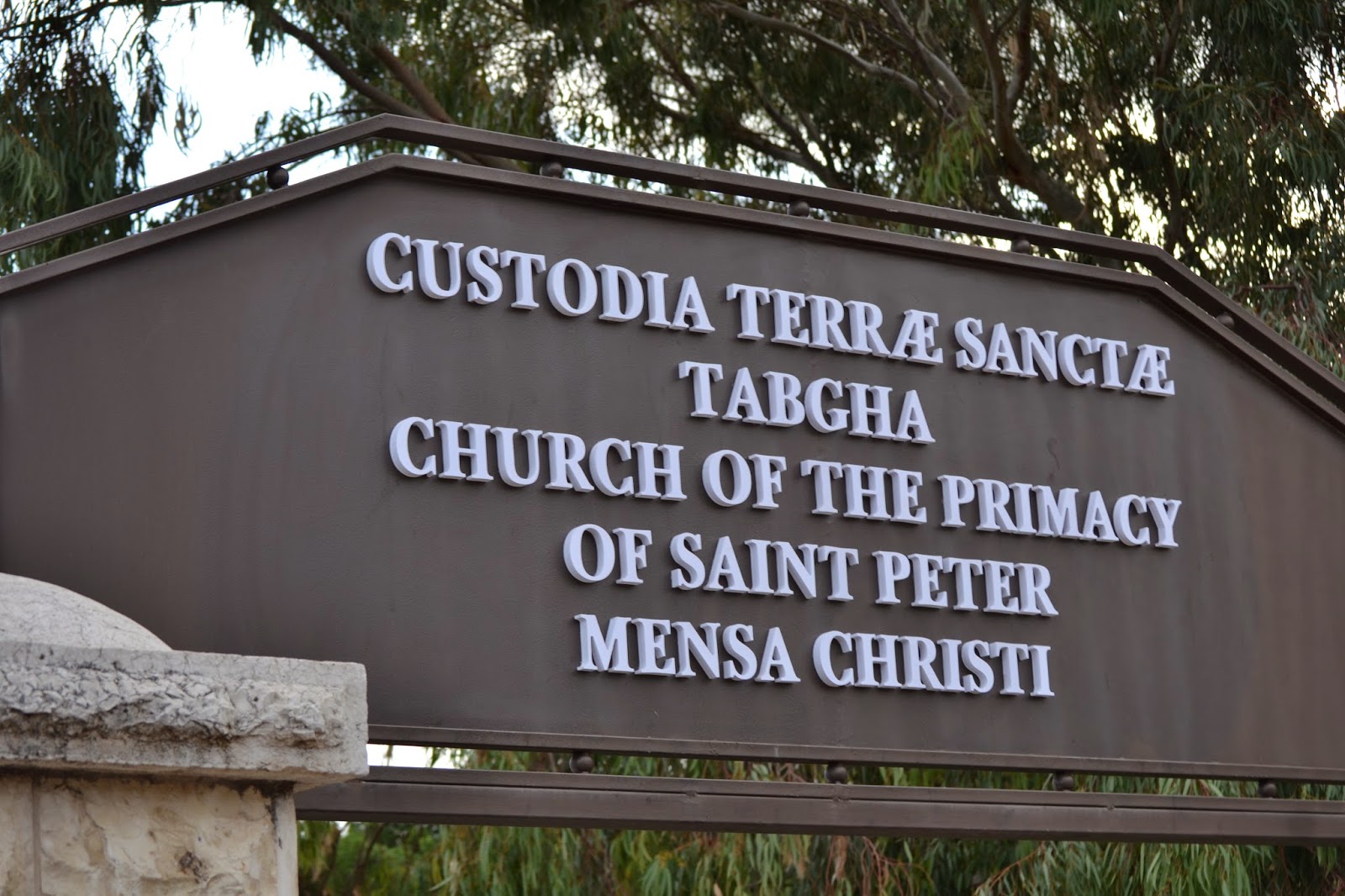
Tradition says that this breakfast meal was shared on this rock which makes up the altar of the Mensa Christi. Jesus did not greet Peter with words of recrimination or judgment, but addressed him with love, asking Peter three times to confess his love for Jesus; each proclamation erasing an earlier denial.


Jesus know that Peter had betrayed him and was a sinner. Why does he choose Peter to be the leader of his church on earth? Why not choose one of the other disciples - someone who hasn't let him down? Jesus knows Peter's heart. Jesus also wants to model for his disciples, and for the world, the way of forgiveness. Reminisicent of the Parable of the Prodigal Son, Jesus goes beyond what is expected to put things right with Peter. More than just forgiveness, Jesus restores Peter to a right relationship: Christian reconciliation motivated by love. What a lesson for us!


Jesus knows Peter's heart. Jesus takes Peter's love and directs it out into the world - calling him to be a shepherd and a fisher of men. At this moment on the beach Peter could not have known what was in store for him. He said "yes" to Jesus not out of his belief in himself or his belief in his abilities, but because of his belief in Jesus. We know that Peter was up to the task, and that he was able to give this same gift of forgiveness many times over the remainder of his life.


As Christians we must be able to both forgive and be forgiven. Forgiveness gives life both to the giver and the recipient, and frees us from spiritual death. Only when we are free can we respond to Jesus' call to "Follow me!"

Monday, August 4, 2014

Pray for Peace


In March 2014, I was privileged to travel to the Holy Land. I would not be able to go today. With travel advisories and flights being cancelled, it is no longer safe to make this pilgrimage.  Sacred spaces are being violated by guns, rockets and bombs.That saddens me. This trip was important to me on so many different levels.  I was able to understand Jesus in relation to his surroundings.  So many of the Bible stories came into clearer view.  I want to go back - but not now. This picture was taken in the Garden of Gethsemane.  Here Jesus surrendered himself to death on the cross.  Let this "thin place" be a conduit for our prayers for peace and understanding.


Before our trip we read Blood Brothers, by Elias Chacour.  He writes from the viewpoint of a Palestinian Christian - a viewpoint I had never considered.  I encourage you to read this book, or one of the many others like it.  There is another point of view.


While we were in Israel we were exposed to the Palestinian people - do you know any? They are people just like us.  The majority of them are not terrorists or members of HAMAS. They are confined to a small area in Gaza, the West Bank, and the Golan Heights. They possess no citizenship and no rights.  This is not justification for violence, but not an unexpected consequence.  I'd never considered that before.


Modern-day Israel is a land of warning signs and checkpoints.


Armed soldiers and/or military drones were at all the places we visited.


As we traveled to the Jordan River to renew our baptismal vows, we were reminded that the surrounding area is still heavily mined, very recently serving as a military area.


The Church of the Nativity was guarded by a Palestinian soldier.  The sacred and secular collide at every turn.


This is a complicated situation and there are no easy answers. Please pray for God's guidance for those in power and for those without power.  Pray that calm can return to the land where our Savior walked. Pray for peace!

Thursday, July 24, 2014

The Journey of a Lifetime Begins With a Single Toe


My ruminations about Israel have been interrupted by another trip.  On July 7 we embarked on a Holland America Land+Sea adventure to Canada and Alaska.  It was a trip of firsts.  Though we had been to Canada and Alaska before, this time we were venturing north of the Inside Passage and were journeying to the Klondike Gold Fields.  I guess it was the continual stories of pioneers, frontiersmen, shills, and native peoples that made me a little more adventurous this time around.

In Dawson City, in the Yukon Territory, I was introduced to the "Sour Toe Cocktail" served up at the Downtown Hotel.

From the Dawson City website:

The legend of the first “sourtoe” dates back to the 1920’s and features a feisty rum-runner named Louie Linken and his brother Otto.  During one of their cross-border deliveries, they ran into an awful blizzard.  In an effort to help direct his dog team, Louie stepped off the sled and into some icy overflow—soaking his foot thoroughly.

Fearing that the police were on their trail, they continued on their journey. Unfortunately, the prolonged exposure to the cold caused Louie’s big toe to be frozen solid.  To prevent gangrene, the faithful Otto performed the amputation using a woodcutting axe (and some overproof rum for anesthesia).  To commemorate this moment, the brothers preserved the toe in a jar of alcohol.

Years later, while cleaning out an abandoned cabin, the toe was discovered by Captain Dick Stevenson.  After conferring with friends, the Sourtoe Cocktail Club was established and the rules developed.  Since its inception, the club has acquired (by donation) over 10 toes.


So...you show up at the Downtown Hotel, buy a shot of Yukon Jack for $5 and wait in line to see the "Toe Captain."  For an additional $5 he will pronounce the rules: "Drink it fast or drink it slow, but your lips have gotta touch the toe."


He drops the gnarly toe in your glass and you drink it down!


Oh yeah, there's a hefty fine if you swallow it...yuck. The Captain said they are down to their last toe.


If you pass the test, which I did, you get a certificate and are a member of the club. I still can't believe I did it!

Sunday, July 6, 2014

The Holy Land - The Fifth Gospel


When we were in Israel, I became introduced to the  writings of Bargil Pixner.  He was a Benedictine monk who lived in Israel for 25 years, half of that time at the Sea of Galilee.  He believed that the land itself was the Fifth Gospel - that you would not fully understand the Bible without also understanding the land where it was set.  He believed that God's revelations were made in a particular time and in a particular place. By understanding the biblical landscape, Pixner believed that we can "experience the four Gospels with a new and greater clarity."  His books with Jesus through Galilee according to the fifth Gospel, and with Jesus in Jerusalem - His First and Last Days in Judea, are beautifully photographed and full of insights drawn from the physical topography of the Holy Land. I thoroughly recommend them.


This was our first glimpse of the Sea of Galilee - which is actually a fresh-water lake.  It is also known as Kinneret, Lake of Gennesart, or Lake Tiberias.  The majority of Jesus' ministry took place in the area of the Sea of Galilee - in what is often called "The Evangelical Triangle" - from Capernaum to Korazin to Bethasida.  This is where the marjority of Jesus' miracles ocurred.  The first side stretched from Tabgha-Eremos-Korazin.  The second stretched from Korazin along the Roman road to Bethasida.  The lake shore from the mouth of the Jordan as far as Tabgha forms the base of the triangle, with Capernaum in the middle of the base of the triangle.


Tiberias is located on the Sea of Galilee. There is no record of Jesus ever visiting Tiberias. He probably avoided this area, as it was the home of Herod Antipas. Tiberias is located on the west side of the Sea of Galilee.


These are ruins in the Tiberias area dating back to the time of the Ottoman Empire. The building stone is basalt - volcanic rock.


These are the Golan Heights. Even though it comprises a large amount of land, only 8,000 Palestinians are allowed to live here, under very strict restrictions.


Here we read Mark 1:16-20 about the calling of the apostles. It probably happened in this area.


This is the rock where tradition says Jesus dined with his apostles after the resurrection.


Here Jesus forgives Peter for denying him.


We ended our day at the beautiful Ein Gev Kibbutz on the shore of the Sea of Galilee. We each had a cabin right on the water's edge. It was stunning!


Our view of sunset on the Sea of Galilee from our cabin. What a beautiful end to a wonderful day! Shalom!